





Atmosphere LogiQ and FEQ LogiQ
Every recording, at its best. Automatically.
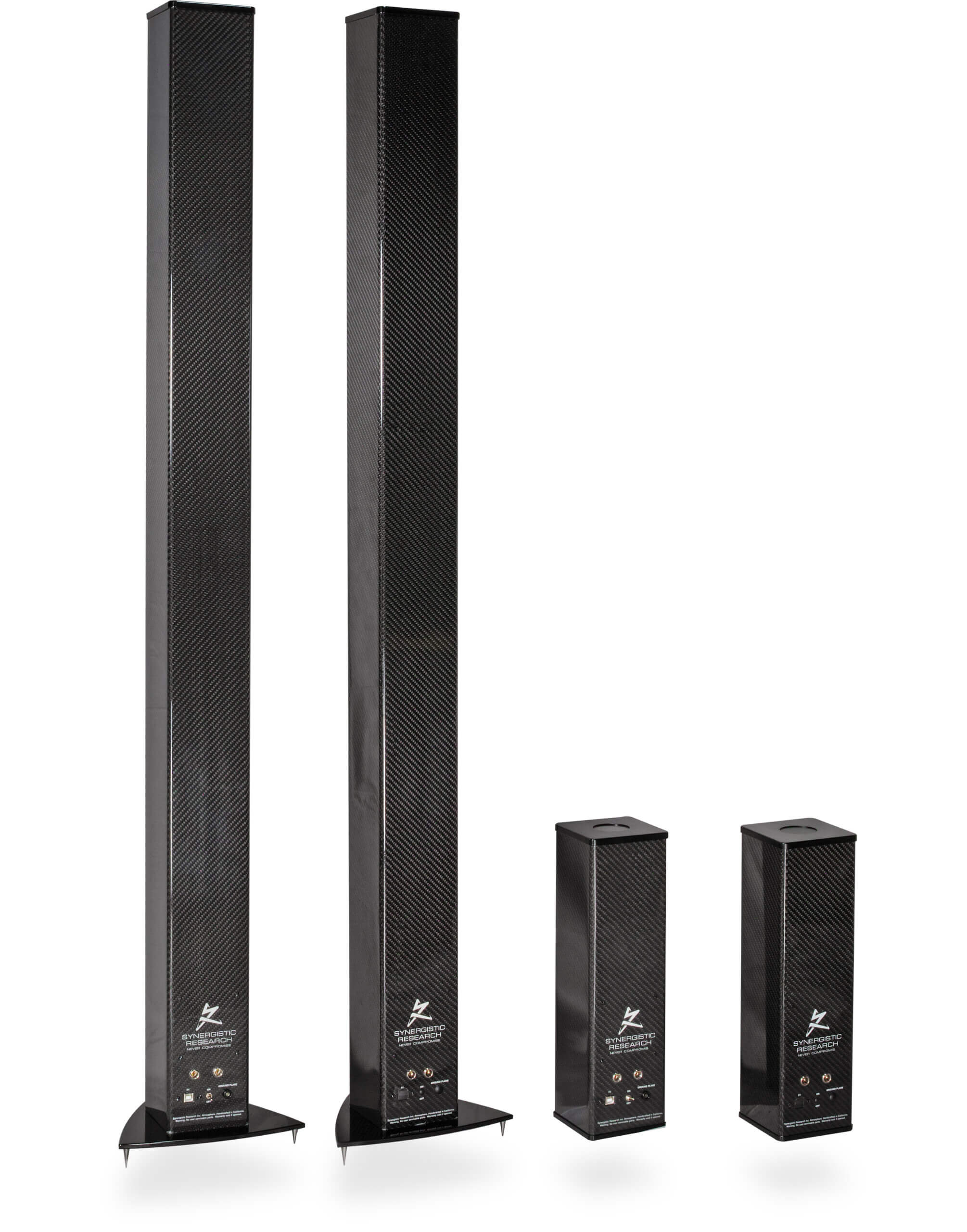
LogiQ makes your system sound its best on whatever you play, by intelligently tuning the field of energy your electronics sit in to match the music. It changes nothing in your signal path, and it does the work for you.
Atmosphere LogiQ is the larger of the two towers, at 54-inches and with stronger broadcasting power, suited to bigger rooms and systems with many components. FEQ LogiQ stands 16 inches and runs the identical platform for smaller rooms and second systems, or works as a satellite alongside the larger tower when a system is spread across two locations in a room. One reaches farther. Both are run from the same app, and both give you the full intelligence described below.
The Big Idea
Sound Is Shaped by More Than Your Components
Start with an idea most listeners never consider. Your electronics do not operate in empty space. Every powered component sits inside an electromagnetic field, an invisible field of energy that the components generate themselves and that surrounds every cable between them. That field has a real effect on what you hear. And it gets worse the more digital gear you own, because chips inside streamers, DACs, and computers throw off high-frequency electrical noise that rides along your cables together with the music, and that noise flattens the sound and hardens the high frequencies before it ever reaches your speakers.
For thirty years, Synergistic Research has studied that field and built ways to control it. LogiQ is the intelligent version of that work. Atmosphere LogiQ and FEQ LogiQ are field generators, which means they broadcast an engineered field of their own around your system. That field is tuned to the range that sits naturally close to music, and it takes precedence over the high-frequency digital noise, clearing a cleaner path for the signal to travel. Nothing connects to your components. Nothing processes the music. The field does its work in the space around the system, not inside it.
What makes LogiQ new is that it thinks. It recognizes the track you are playing and sets the field to suit it, since a delicate acoustic recording and a large electronic production want very different things. You can refine the result just by telling it what you want to hear. It remembers the settings you love, and over time it learns your taste and adjusts toward it. The payoff is simple to state and hard to overvalue: your system sounds its best on everything you play, the adjustment happens on its own, and you never touch a cable or a component to get there.
A word on where it fits, because we would rather tell you plainly than oversell. LogiQ rewards a system whose fundamentals are already in good order: speakers sensibly placed, a room without gross problems, a coherent set of cables. It is not a patch for those things. On a system that is broadly sorted, it opens up depth, space, and ease that the components could always produce but never quite delivered.
Track Lookup
The Right Field for the Track Playing
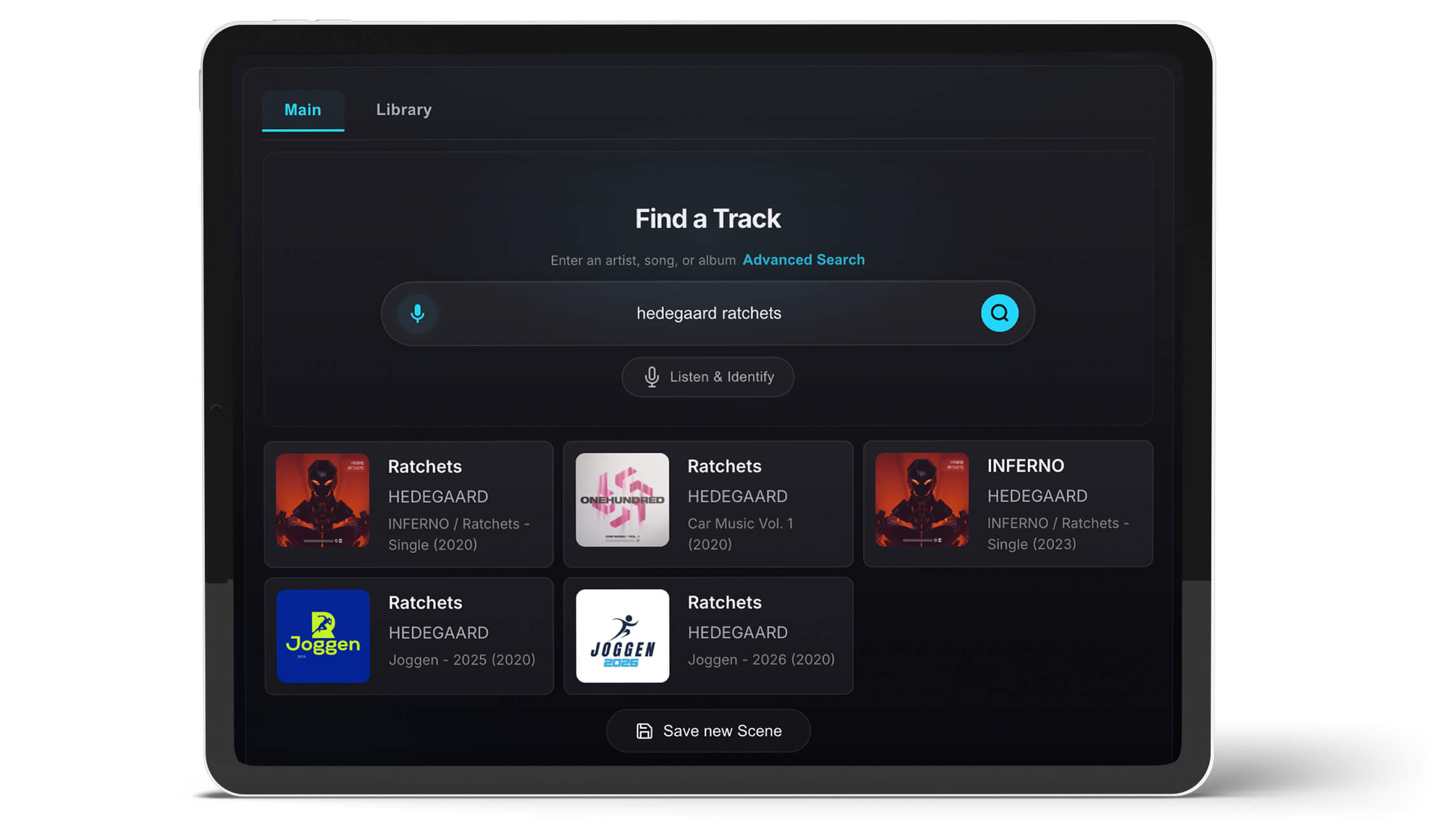
No two recordings ask the same thing of a system. A close-miked jazz trio and a big electronic production want opposite shapes from the field between your speakers. Track Lookup identifies the recording as it plays, the way a music app names a song it hears, then sets the field to a starting point matched to it. That starting point comes from the settings lead designer Ted Denney arrived at by ear, what audio people call a voicing, applied to your system in a tap.
The starting point is exactly that, a start. From there LogiQ refines toward what the recording needs and what you have taught it to like. Settings you have saved for a particular track take priority over everything else, so a track you have already dialed in comes back exactly the way you left it.
You press play. It does the rest.
The Library
Save It Once. Recall It by the Cover.
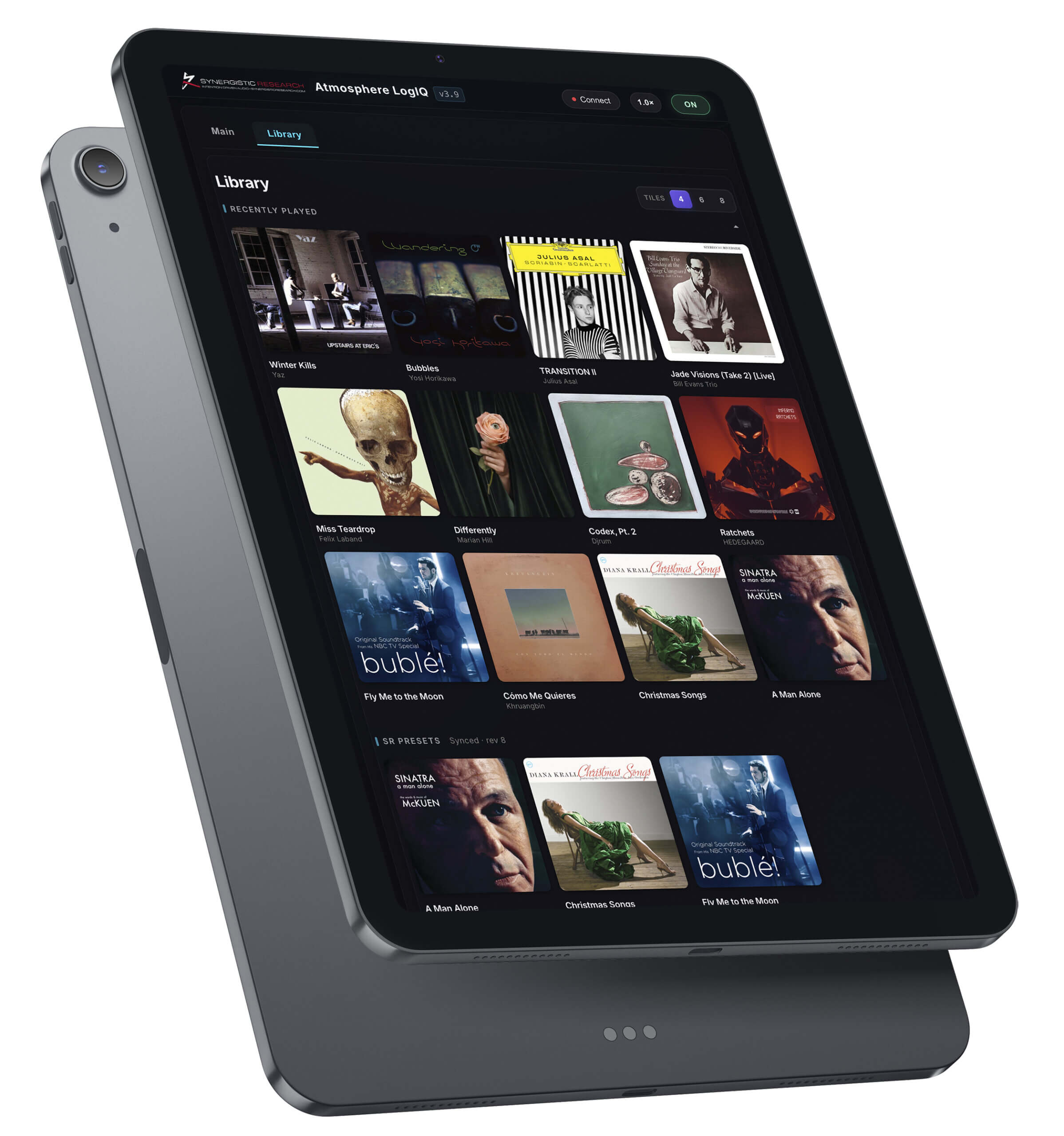
A setting you arrived at over an evening of careful listening is worth keeping. When you save one, LogiQ files it in a gallery under the cover art of the track you were playing. Weeks later, reach for that cover and the setting returns, ready for that track or anything close to it.
Settings save as files you can keep and move between systems, and you can share them with other LogiQ owners, so a field you spent an hour finding takes someone else a single tap to load. The more people use the platform, the deeper the shared library of starting points becomes.
You built the system. This is where you keep the way each recording should sound on it.
Frequency and Waveform
The Problem With Digital Was Never the Format
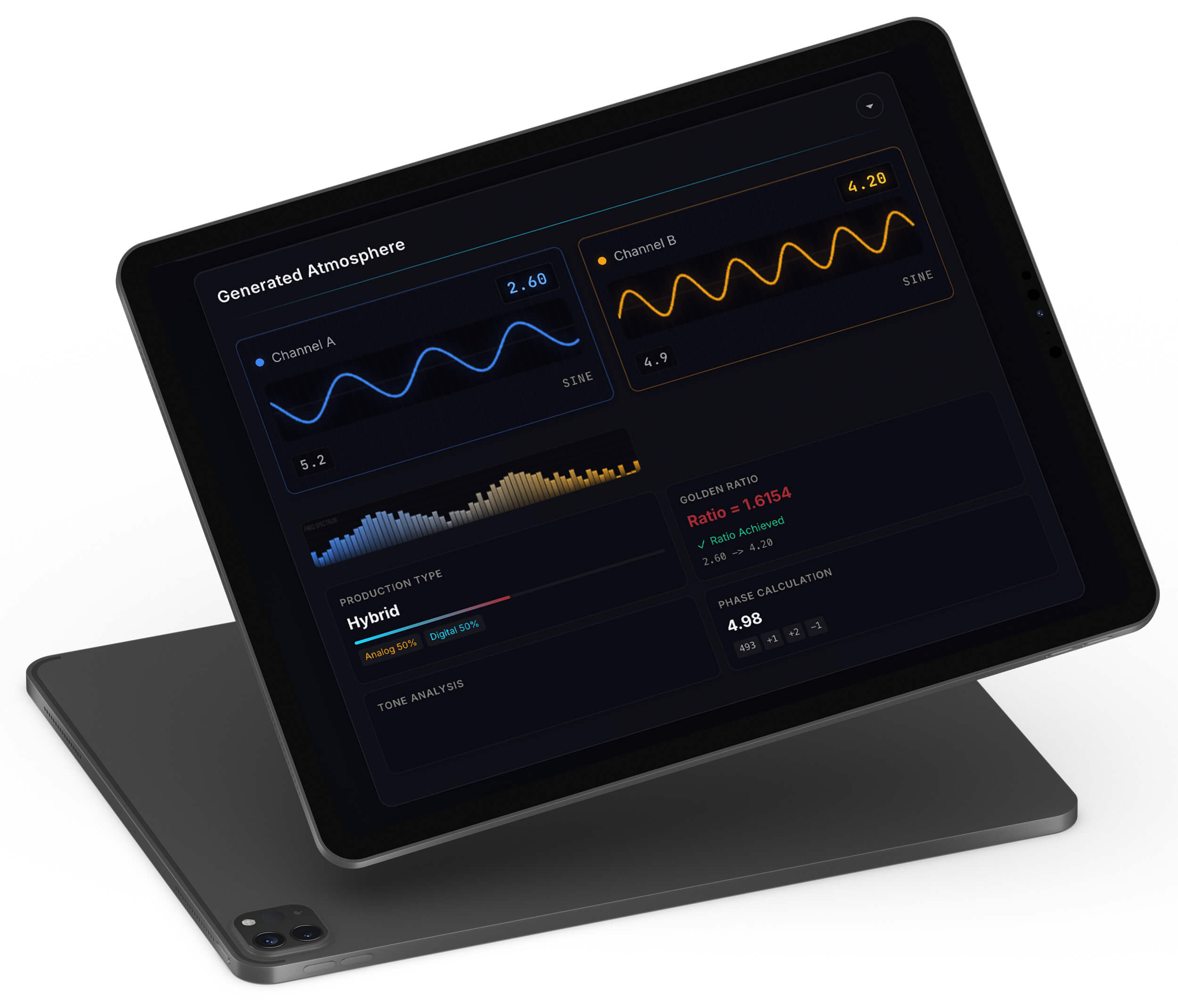
Here is the part worth understanding, because it explains everything else. The weakness people hear in digital sound is not the digital format itself. It is a byproduct. The processor and memory chips inside any digital source give off high-frequency electrical noise, in the megahertz and gigahertz range, far above anything you can hear. That noise does not stay inside the box. It travels out along your cables, in the same path as the music signal, and it distorts the shape of that signal before it reaches your speakers. Compared directly to the best analog sources, that is what makes digital sound flatter and less dimensional, and what adds a hard edge to the highs.
LogiQ addresses this where the field is made. The tower broadcasts low-frequency energy, the kind that sits naturally close to the range of music, and it can shape that broadcast into different waveforms, the smooth curve of a sine, the hard edge of a square, the ramp of a sawtooth, each with its own character. That broadcast biases the field your signal travels through. It does not erase the high-frequency noise. It takes precedence over it, because the field is stronger and because low-frequency energy is a far closer match to music than that high-frequency hash ever is.
The number of possible settings is enormous, over a trillion combinations, which is exactly why an intelligence layer earns its place navigating them for you. Frequency and Waveform is where that navigation opens up for the listener who wants to reach in and set the field by hand. Not just how much field. Which field.
Spatial Contour
Shape the Stage to the Recording and the Room
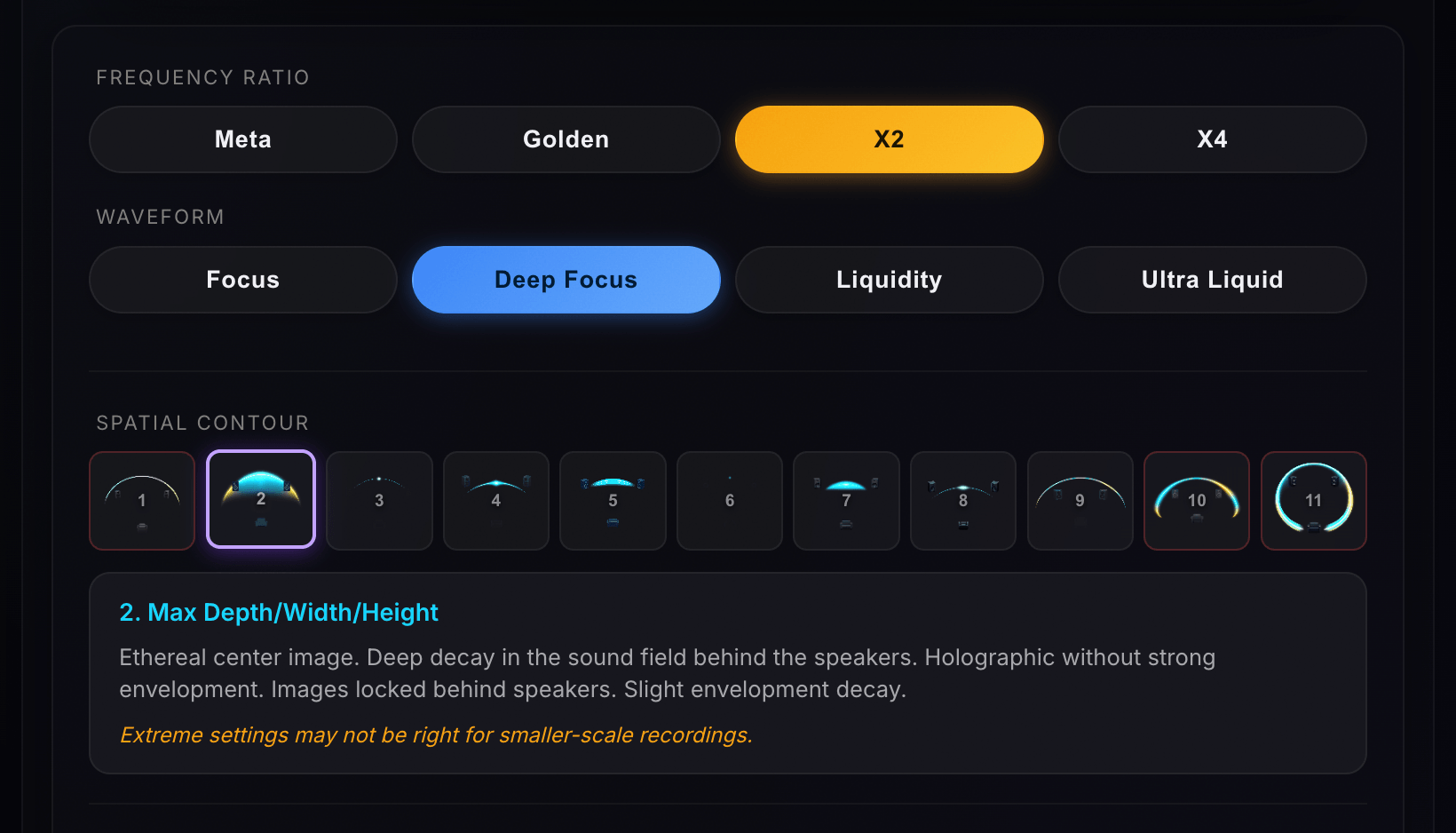
When a system is set up well, the speakers seem to disappear and the music appears as a stage of sound in front of you, with width, depth, and height. That stage is shaped by the field between your speakers, and Spatial Contour lets you shape it directly. Choose a deeper stage that layers performers front to back, a wider one, or an enveloping field that seems to wrap around the room.
The field works with your room. Where a system includes acoustic treatment, meaning panels or resonating devices placed around the space to manage how sound behaves, LogiQ has more to work with and the sense of envelopment grows. With less in the room, the effect is gentler. Match the contour to the recording, spacious depth for a live concert, focus and immediacy for a studio session, or simply match it to the mood of the evening. The change takes effect as you make it.
You have spent years getting your speakers to disappear. This decides what appears when they do.
The AI Sound Engineer
Say What You Want. It Sets the Field.
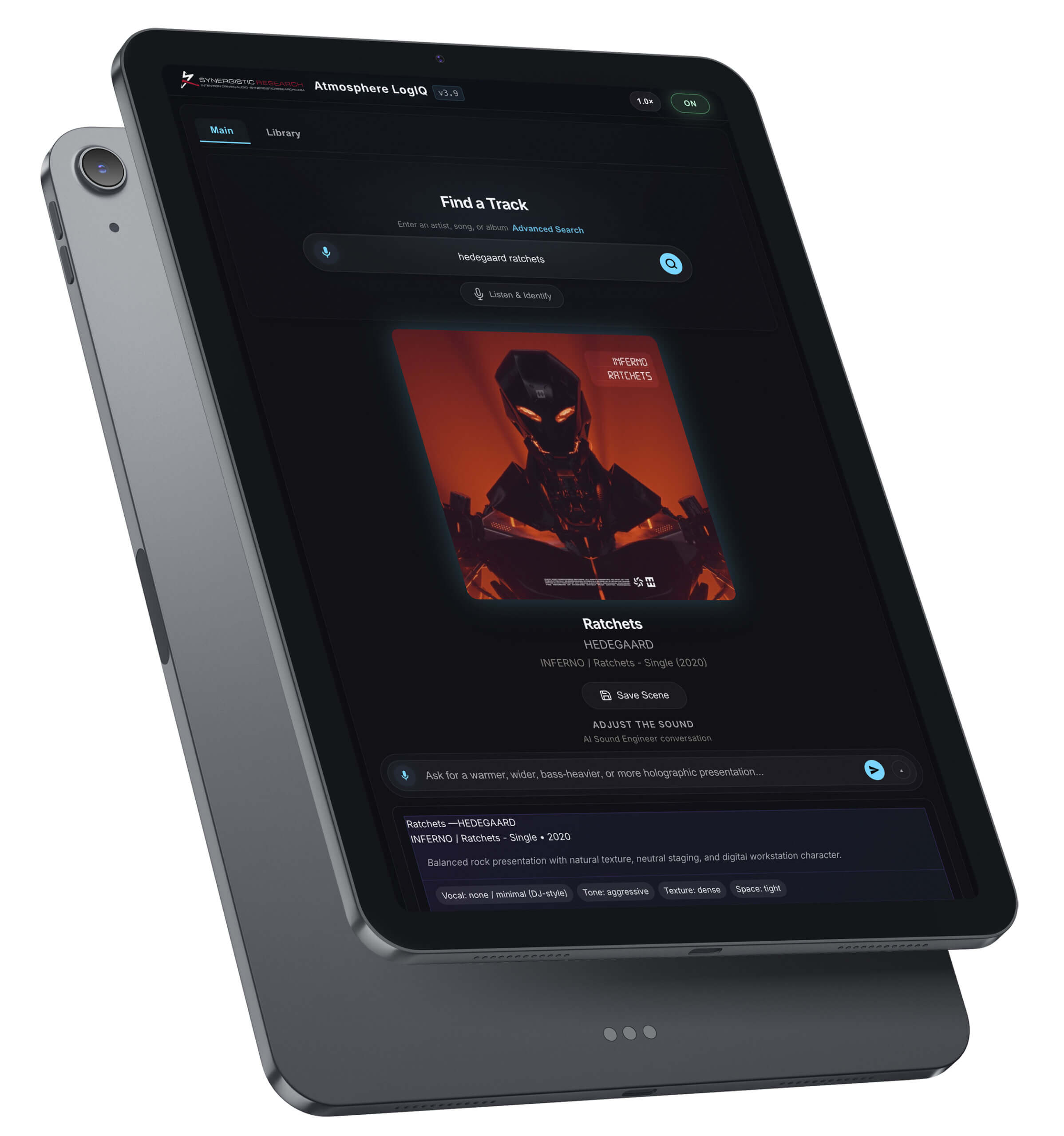
You know what you want to hear. You do not always know which setting delivers it, and with more than a trillion of them, no one could. The AI Sound Engineer removes that problem. After Track Lookup sets the starting point, tell it in plain words, “give me smoother vocals,” “more space between the players,” “bring the singer forward,” and it adjusts the field and tells you what it changed.
It is honest about its limits. Push a setting too far and the image starts to lose focus, and you hear it happen, so you always know when you have gone past what serves the music. Work by voice, tap the on-screen controls, or ignore the suggestion and set things yourself. The point is not to take control away from you. The point is to make the whole field reachable through the one language every listener already speaks: a description of the sound they want.
Think of it as a knowledgeable friend at the rack, not a manual you have to read.
LogiQ Thinking
Logic, Plus IQ. That Is the Whole Idea.

The name says what it is: logic and IQ. A field with more than a trillion possible settings is larger than any person can hold in their head, even after years of learning its patterns by ear. The work behind LogiQ was teaching a computer model to understand those settings the way a listener does. Describe how a setting sounds, change it, describe how the sound changed, and repeat that across enough sessions, and the model learns to predict how any given adjustment will move the stage. That is what it means to say LogiQ mapped the field.
Left to run on its own, this kind of model tends to drift and invent. So LogiQ runs a second layer of software whose only job is to keep the model honest, holding its answers to what it has actually learned rather than what it might guess. The result reasons about your particular system and scales its suggestions to what you own.
Then it learns you. Every time you adjust a setting and save it, LogiQ reads that as a preference. Do it enough and it stops defaulting to the factory starting points and recalibrates toward your taste. This is the quiet advantage of the whole platform. The more you listen, the more it knows, and the less you have to do to hear your system at its best.
Three Ways to Listen
Choose Your LogiQ Plan
Every Atmosphere LogiQ and FEQ LogiQ owner starts with LogiQ Basic at no cost. Two paid tiers open deeper control for listeners who want it. The hardware is always yours, and the core of the platform never sits behind a paywall.
| Capability | LogiQ BasicFree | LogiQ Plus$29.95 / mo | LogiQ Sonic Mastering Lab Plus$55 / mo |
|---|---|---|---|
| Core field control and factory settings | ✓ | ✓ | ✓ |
| Track Lookup (recognition and starting points) | Limited | ✓ | ✓ |
| Spatial Contour | Basic contours | Full range | Full range |
| Album-art preset Library | Limited saves | Unlimited | Unlimited |
| Library export, import, and sharing | ✗ | ✓ | ✓ |
| AI Sound Engineer (conversational tuning) | ✗ | ✓ | ✓ |
| Frequency / Waveform deep control | ✗ | ✗ | ✓ |
| LogiQ Thinking personalization | Standard | Enhanced | Reference grade |
| Cloud sync across devices | ✗ | ✓ | ✓ |
Pricing and tier contents provisional, pending Synergistic Research confirmation.
Good to Know
Frequently Asked Questions
What is LogiQ, in one sentence? It is an intelligent field generator: a device that broadcasts an engineered field around your system, tuned automatically to the music you are playing, to make your existing system sound its best. It connects to nothing in your signal path.
Is this an equalizer or signal processing? No. An equalizer or a digital processor sits in the path of your music and alters the signal itself. LogiQ never touches your signal. It has no electrical connection to your components at all. It shapes the field of energy around the system, and leaves the music untouched.
Do I need other Synergistic Research products to use it? No. LogiQ works on any system. It works most fully when paired with SR cables and acoustic products, which are engineered to respond to the field, so owners of those will hear the most. It does not require them.
Will it fix a bad room or a poorly set-up system? No, and we will say so plainly. If your speakers are badly placed or your room has serious acoustic problems, address those first. LogiQ brings out the best in a system whose fundamentals are sound; it is not a substitute for getting them right.
What is the difference between Atmosphere LogiQ and FEQ LogiQ? Size and reach. Atmosphere LogiQ is the 54-inch tower with stronger broadcasting power, for larger rooms and bigger systems. FEQ LogiQ is the 16-inch tower, for smaller or second systems, or as a satellite alongside the larger one. Both run the full platform.
Do I need both? No. One tower serves one system. You would add a second only to cover a system split across two locations in the room, or a separate second system.
What do I control it with? The LogiQ app runs on iPhone, iPad, and Android devices, and the towers are managed entirely from the app.
Is there a way to try it? Yes. You can audition LogiQ in your own system through an authorized Synergistic Research dealer.
The Last Step is Listening
Add the Missing Piece
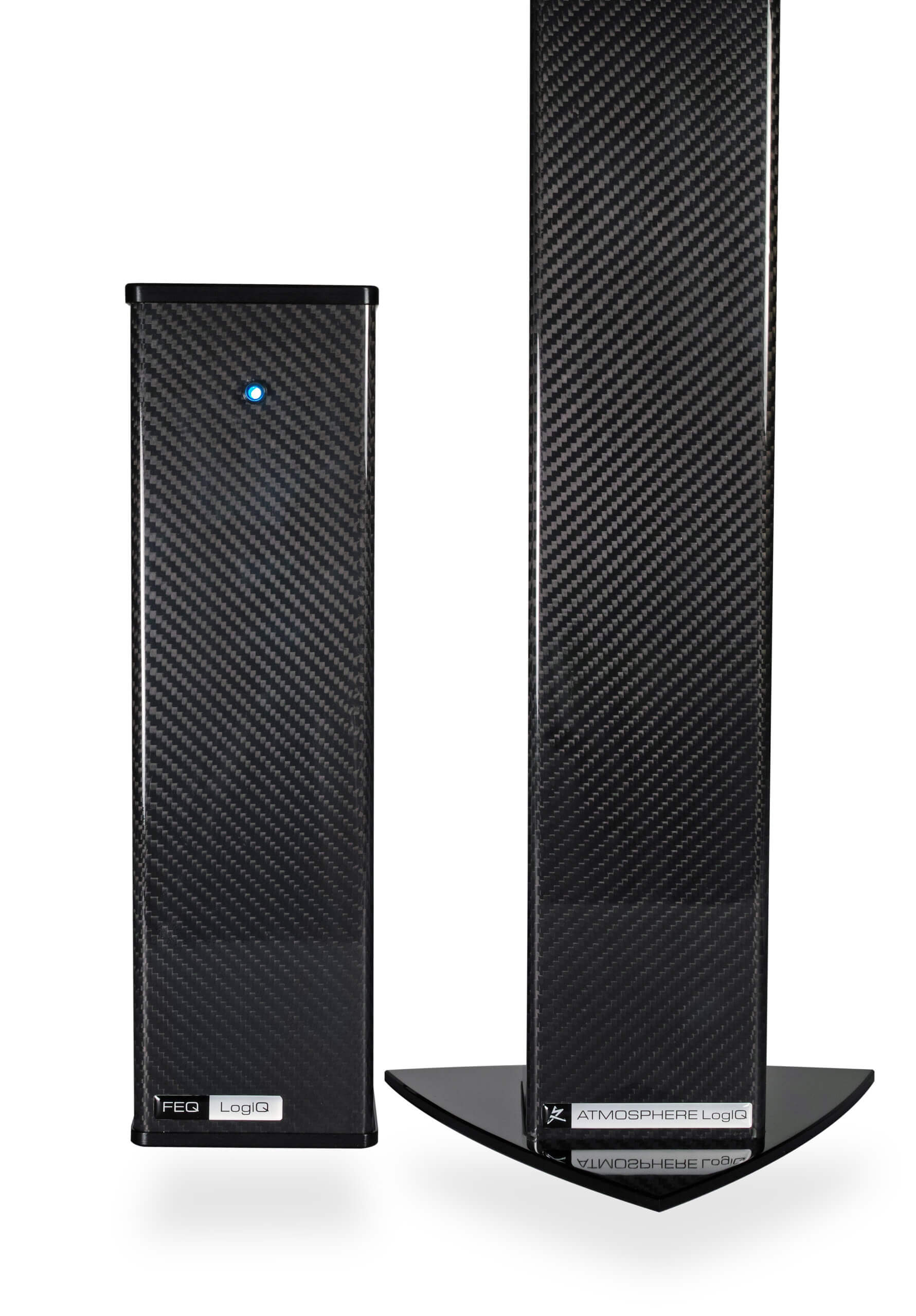
You have chosen your components, placed your speakers, and lived with your system. The field they all share is the one part you could never reach, and it is the part Synergistic Research has spent thirty years learning to control. Atmosphere LogiQ and FEQ LogiQ hand you that control, and the LogiQ app makes it effortless to use.
The rest is listening.
Buy Atmosphere LogiQ: $5,495
Buy FEQ LogiQ: $3,495